Note: This website contains almost no TokiMemo content.
In fact, this picture is the only reference at this point.
My favourite handhelds of Summer 2025Post 00060 | July 30th 2025
Last autumn, I posted about a couple of my favourite emulation handhelds. They keep making new models at a rapid pace (and for some reason I keep buying them).Seeing how Summer is the ideal time for portable gaming, I figured I'd come with a couple of updated picks if you're in the market for one of your own. Retroid Pocket Mini V2
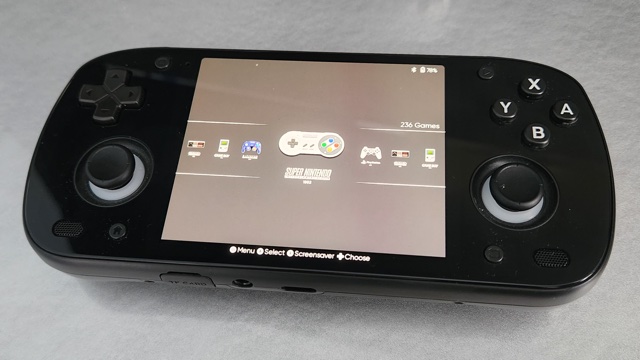
A rant about the V1My first pick is the Retroid Pocket Mini, but only the revised V2 model. Before I get to telling you about it, I'd like to have a rant about the original V1 version - If you want to skip it, head on down to the next section. I have a passionate love-hate relationship with the Retroid Pocket Mini. When the first edition of the console was announced, I was very excited about the screen; An 960p 4:3 AMOLED screen seemed like something that was just made for retro gaming (foreshadowing is a narrative device…). Not only will it let you integer scale 240p and 480i content, its SoC is also powerful enough to play pretty much any 4:3 system. I immediately made an order for an orange and white model. I couldn't think of a more summery colour combination - It's like a Solero ice cream! Upon its arrival, it would appear the ice cream in my Solero had gone sour. Somebody had messed up during the assembly of this thing and used a gray faceplate instead of a white one. Oh well, I thought, I can live with gray and orange. Still, it doesn't bode well for their quality control that they don't notice the front of the device is the wrong colour. I decided to live with it. I started setting it up and was very happy with its performance until I started applying shaders. There was something wrong: Shaders didn't align properly, making the effect look kind of off. I suspected it was because I was using a newer version of Retroarch than I was used to; It looked like they'd made some changes to the scaling settings. No matter what I tried I couldn't make shader look right, so I decided to play without shaders until Retroarch would send out an update to fix their scaling issues. This is when I learnt the screen was actually at fault. It was some kind of firmware issue that couldn't be fixed with an update. Retroid were offering refunds, but in the weirdest way possible: Not only was there a time limit; There was also a limit on the number refunds they would do. I heard this in a video by RetroGameCorps, a YouTuber not directly affiliated with the company. Apparently, Retroid are doing their service announcements on Discord; Strange, seeing you can only buy their consoles from their website, which means they have the email address of every single affected customer. I didn't bother checking if the refund window was still open; The video had been up for days at this point, and the Discord post even longer. Even later, it was found out the reason for the firmware bug was self-inflicted. The panel wasn't a 960p panel at all, but rather a 1240x1080 one. In theory it would work: Disable some pixels in the firmware and cover the disabled pixels with a bezel. I'm not sure why they would do it, but considering how excited I was about seeing a 960p screen in the spec sheets, I assume this might be part of the reason. Anyway, this is the reason why the scaling didn't work. This time they decided to offer a replacement front bezel but once again, this was a limited time offer announced on Discord. Like last time, I heard about it in a YouTube video, but seeing how their replacement screen had already arrived from China, the offer had long expired. I managed to convince them to send me a replacement if I paid the $15 shipping fee. The replacement screen only comes in black, inching me ever further from my Solero dreams. They've now started to sell a v2 version - A version without the bezels letting you use the entire screen. I'd suggest you go this route rather than upgrading a v1; Even if you manage to get a replacement screen, actually replacing isn't really for the faint of heart. After this, you also need to wipe your device to make it recognise the new screen resolution. I ended up just picking up a V2, leaving my V1 as a display piece to never remind me to get excited about a pre-order. Retroid Pocket Mini V2You'd think with such a bad experience, I'd have a hard time recommending it. Thing is, it's a bloody good handheld and its the model they should have made in the beginning. The revised (or unrevised, depending how you look at it) screen is very vibrant and the increased resolution only makes it even better. The 3.92" AMOLED screen with a resolution of 1240x1080 or a 31:27 aspect ratio. While this isn't exactly a common aspect ratio, it isn't an unusable one either. The SNES outputs at 8:7 (or 32:28), which is pretty close to this screen's aspect ratio. I can fill up the screen with a 5x integer losing only a few pixels on either side. It's almost the same screen ratio as the Game Boy and the Game Gear. Of course, it still play 4:3 games as well as the v1. The v2 only comes in black, which is not a bad thing: Black bars on the AMOLED screen are nearly indistinguishable from the bezel so letterboxing isn't as noticable. It's no solero, but it's not bad. Of course, it takes more than a screen to make a handheld. The fact of the matter is, I think they've really checked all the boxes this time. It's has a pocketable size, and it's rounded edges make it slip easily into the pocket and make it feel good in the hand. Controls are responsive, with the d-pad using a combination of rubber membranes and tactile pads. You get the clicky feedback of the tactile pad, but it's comfortably dampened, both for your finger and your ears. The ABXY buttons are membranes only. Both the analog sticks and triggers are hall effect, feeling silky smooth. The sticks are replaceable, but in my experience they tend to fall off on their own if the console is stored loosely in a pocket. Retroid sells replacements if you should lose them - otherwise you might consider giving them the tiniest drop of glue - Or maybe just use a case. As for ports, there's a USB-C fully hooked up for docking if you want video out, a micro SD card for storage expansion, and a headphone jack that also supports microphones. Inside the console there's a Snapdragon 865 processor, a fairly capable smartphone CPU from 2020. It struggles with some of the more demanding Wii and PS2 games, but should otherwise be able to keep up with 4:3 systems. There is a fan to cool it, but frankly I would usually just leave it off. For most emulation you don't need it on. If your device gets uncomfortably warm you can switch it on from the notification panel without leaving the game you're playing. It's running Android. In some ways I prefer it over Linux, at least when the device is powerful enough to run it. It connects as easily to wifi and Bluetooth as your phone does, and there's a good selection of emulators available - all downloadable from the device. It has a touchscreen, so there should be no problem using a smartphone OS either. I ditched the included launcher for Emulation Station. It's a paid app, but you purchase it as a one-time fee via their Patreon rather than the Google Store; Perfect if you don't want to log into your Google account on the device. Once you've paid, you'll receive emails with an apk link every time they release an update. Speaking of not wanting to log into the Play Store, I recommend using the Aurora Store for downloading your apps and emulators. It's basically an alternative storefront for the Play Store that you can access without logging in with your Google account. Of course, you can also sideload apps that you download from a browser. It'll run pretty much anything a normal Android phone can run: syncthing-fork for syncing, a wealth of file browsers (I use Total Commander), and even media apps if you want to use that AMOLED for something else than gaming - The world is your oister. It kind of reminds me of the PSP back in the day; Apart from gaming you could browse the web, watch a movie and call people on Skype. This'll let you do the same, only better with more options. All in all, I am happy with my Pocket Mini - At least the V2 version. Still, at $199, we are definitely stepping into premium territory, which wasn't really reflected in my experience with the V1 - I mean, if you don't notice your front faceplate has the wrong colour, you get the feeling that QA is practically non-existent. Still, I had a good experience with customer support once I finally reached out to them, so it wasn't all bad. Anbernic RG 34XXSP
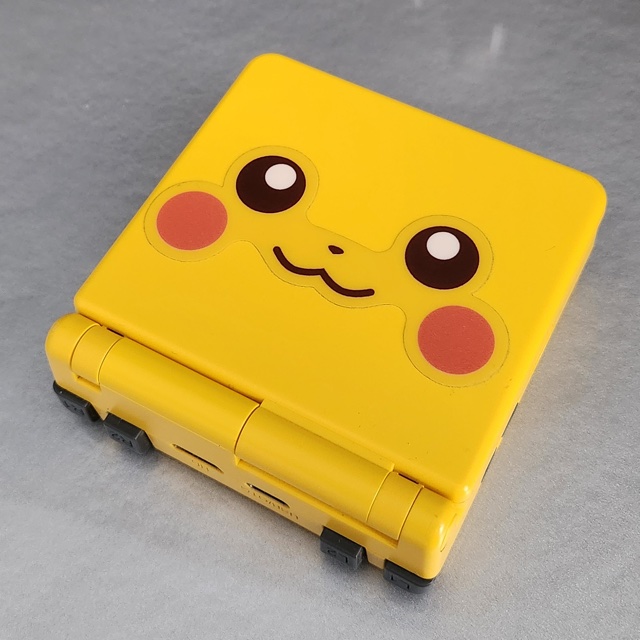
Coincidentally, this one is also a revised version of a handheld that I didn't like at first. I was once again excited when I first saw it; The Game Boy Advance SP has for a long time been one of my favourite handhelds, so when I saw Anbernic was making a clone of it - The RG 35XXSP (35, not 34) - I purchased it straight away. When it arrived however, I was somewhat left disappointed. First up, the RG 35XXSP is a fair bit chunkier than the original, with most of the excess being at the bottom half. I might have looked like an SP, but it didn't feel like one - not in the hand or in the pocket. Also, the controls felt hollow, and cheap, and were incredibly noisy; Not something you could play discretely in public. It became popular to "tape mod" the buttons, literally putting tape over the tactile pads, a bit like how Retroid used membranes for the Pocket Mini. Alas, no amount of tape mods could save it for me. By the time they had reached an acceptable audio level, I had used so much tape that I couldn't press the button down. In the drawer the RG 35XXSP went. Thankfully, they've now made a revised model, in the RG 34XXSP. It's smaller, closely assembling the dimensions of the GBA SP, and has a 3:2 screen, a perfect 3x integer of the original resolution of the Game Boy Advance. Also, it has a 480 pixel vertical resolution, so you can also fit tv-based systems on it just fine. Anbernic's model numbers can look like a plate of alphabetti spaghetti, but there is method behind the madness: 34 is the screen size (3.4 inches), XX is the SoC type (H700, a quad core ARM chip) and the SP is the form factor (like a GBA SP). The H700 isn't as powerful as the RK3566-chip in last year's autumn picks, but more widely supported. I believe this is the tenth device Anbernic has released with this chip. This greater support means you have a lot more firmwares to choose from. Heck, somebody made a website covering the RGXX models and different firmwares. It looks like a lot of the firmware have been discontinued for some time, but there are still others ongoing. Bear in mind that it is still early days for the console, so custom firmwares haven't had the time yet to fully implement the unique aspects of the device. There's a magnet switch inside the lid to tell if its closed or not. To my knowledge only Knulli and Rocknix have experimental builds available that support putting the console on standby when closed. I personally updated to Rocknix's nightly build from their official image. It's working pretty well for me. It's been stable and works with the lid switch. While the Retroid could play practically anything, your options on the Anbernic is more limited - That's how it goes with these H700 consoles. They'll play PlayStation 1, but will struggle with Saturn, Dreamcast and Nintendo 64. You might be able to squeeze a few lower-end PSP titles in if you manage your expectations. This is sort of the minimum you can expect from a handheld, but then again - do you need more? After all, it is a third the price of the Retroid. Controls are much improved compared to the 35XXSP I mentioned before. They're still tactile and clicky, but not as much as the 35. Instead they're a lot closer to the original SP. The 34XXSP also comes with a pair of analog sticks. I'm amazed they managed to squeeze them in, but they aren't necessarily something I find pleasant to use. They're there if you need them and they're recessed enough to not get in the way when you don't. Retroarch's VBA core actually maps gyro controls to the right analog pad, meaning tilt games such as WarioWare Twisted and Yoshi's Universal Gravitation can also be played. Finally, there's also a rumble motor. It's puny, but it's there so we can also check Drill Dozer off the list. That's definitely a good thing that a console designed for Game Boy Advance is able to play as much of its library as possible. One nitpick I still have is how it tends to turn on when I plug it in to charge. Hopefully it can be solved in a firmware update. I kind of miss the physical switches from the original SP. The power switch was an actual breaker, so you always knew when the console was off. Additionally, the volume was controlled with a slider, meaning you could adjust the volume even before you turned it on. You don't see this on many retro handhelds, but I really liked the volume wheel the Miyoo Mini used as well. Still, digital buttons also have their perks; At least in Rocknix you can also use the volume buttons to control brightness if you hold the M button while pressing them so I guess I mustn't grumble. While it is a work in progress, you get a lot of handheld for $67. The original SP has always been a favourite of mine. It's easy to pocket and the GBA has one of my favourite game libraries. Heck, before I got into emulation, I would carry one with me daily. The RG 34XXSP delivers this and much more, along with a couple of extra modern conveniences; No need for a proprietary charger and headphone adapter when you have USB-C and minijack. All for like half the price of what a used AGS-101 would goes for - what's not to love? So, which one do I recommend?This is a tough one, but I think I will have to say the RG 34XXSP - It's become my go to handheld. This might seem weird seeing the Pocket Mini beats it in pretty much every spec, but there's just something cheap and chipper about the little flipper. You can pop it in a pocket without worry and have it ready for quick gameplay session whenever you have a few minutes to spare. It's more limited in what in a can play, but once we get to Y2K consoles, games start getting a lot more detailed to the point you might not want to play them on a sub 4" screen, so maybe you don't need the extra power. That's not to say the Pocket Mini is without merrit - far from it. Android is litterally designed for use with portable devices, and it shows. It has better power management, and is definitely better at connecting to wifi. It also does fast charging and handles bluetooth audio better. Not to mention the entire eco-system of apps. Both handhelds offer excellent value for money, in each their own way. I don't think you can go wrong with either one, but if can settle with maxing out at PS1, the 34XXSP would definitely be my pick.
|